Jeremy Thring at 90: Looking back over seven decades of practice

Jeremy Thring, consultant and former Senior Partner at Thrings, is one of a kind.
Having witnessed the transformation of the legal profession across almost seven decades of practice, he is still actively involved at 90.
Jeremy has spent his entire working life at the firm with his family name over the door, starting his training in 1957 – the year Harold Macmillan entered Downing Street.
Born in Bath in 1936, Jeremy attended Winchester College before enlisting in the Army in 1955, commissioned to the 3rd Hussars and posted to Germany at a moment of genuine Cold War anxiety.
On his return he joined the family firm, at which point he began what he cheerfully describes as “the miserable business” of articles. It was not, perhaps, the most enthusiastic beginning to a legal career. But something, or more accurately, someone altered his view.
Jeremy said, “Everything changed with meeting my wife, Cynthia. When you love someone, you want to do your best for them, to make them proud.
“She was pretty, strong and gentle, and just wonderful. We were together for many years until her passing six years ago and because of her I have two lovely daughters, five grandchildren and one great-grandchild. We are a very close family, which is a blessing.”
Building a modern firm
When Jeremy qualified in 1962, the firm was a respected but modestly-sized outfit of around 40 employees serving landed estates, farming families and trusts. Over the following decades came a period of deliberate and ambitious transformation, with a significant portion supported by Jeremy during his 17-year tenure as Senior Parter.
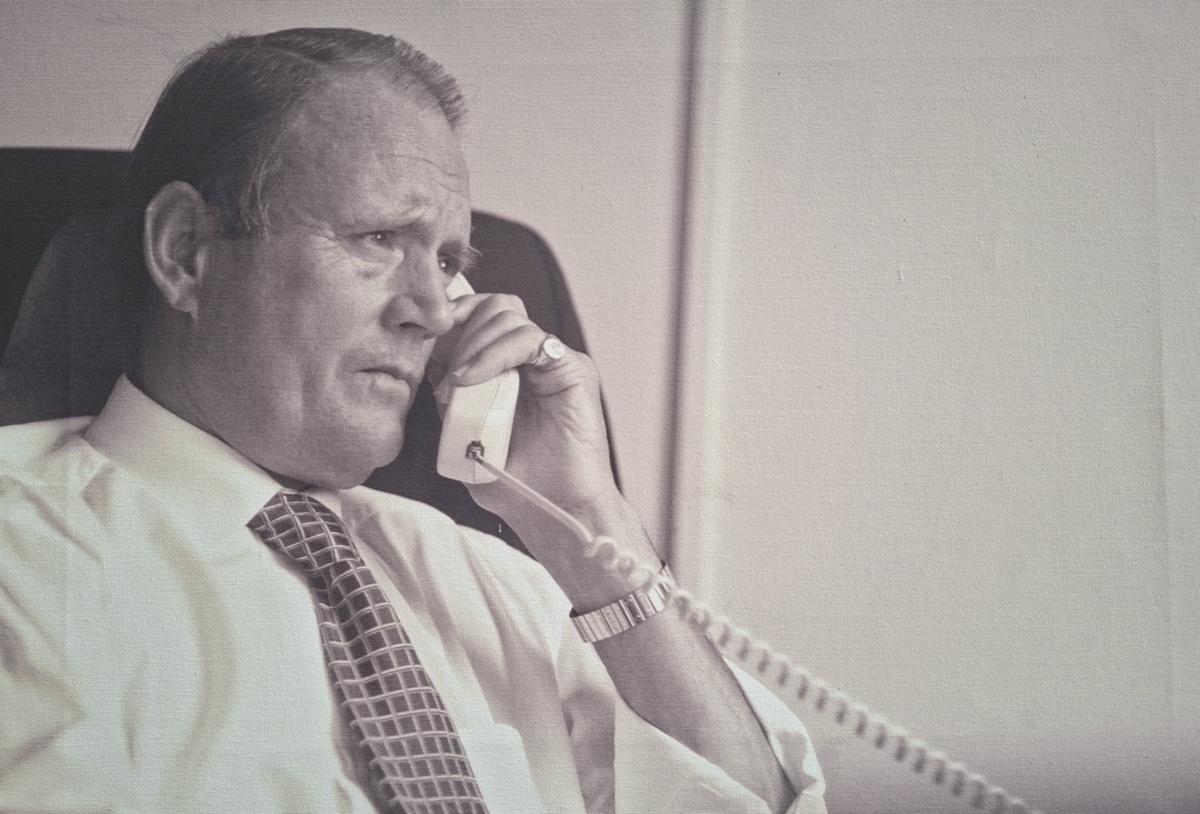
His instinct for growth and his eye for talent would prove to be among his most important contributions to the firm. He pursued mergers strategically, including with Titley, Long and Co. in 1987 – a firm from which Thomas Shepherd would join Thrings and become the next Managing Partner.
Expansion took place along the M4 corridor over the next three decades, with offices being opened in Bristol, Swindon and London.
Jeremy added, “The theory was that the M4 artery was the future. For us in Bath it had to be. What the firm has gone on to achieve in recent decades has been a result of it being extremely well managed and full credit goes to the partners, in particular Simon Holdsworth as the current Managing Partner, for the work they have done.”
Bath – A city like no other
For a man who has spent his entire life and career in Bath, Jeremy’s affection for the city is anything but diminished.
He has watched Bath change across nine decades, and his reflections on that change are those of someone who genuinely cares about what the city was, what it became, and what it continues to be. The post-war years, he recalls, required real effort and real investment. The arrival and growth of the University of Bath is, in his view, among the most significant and positive transformations the city has undergone.
As well as taking on the roles of Chairman of the University’s Council and Prochancellor, Jeremy has also served the Bath community through his work with a wide range of organisations, including Bath High School, the Bath Law Society and the Royal National Hospital for Rheumatic Diseases NHS Trust, the latter of which where he “saw people slowly become themselves again” and, when he would visit patients around Christmas, would see that “without exception, they were all happy to be there.”
His continued service to the community was recognised in 1988 when he was appointed Deputy Lord Lieutenant of Avon and then Somerset in 1996.
On the law and providing a service
Reflecting on the changes he has witnessed across six-plus decades, including a two-year tenure as President of the Bath Law Society (since been subsumed into Bristol), Jeremy’s grounded view of the legal profession’s transformation ranges from technology and the impact of AI to the human element that he believes is irreplaceable.
Jeremy continued, “The law is changing all the time. The technology revolution over the past 20, 30 even 40 years has been huge. Even going back to my father’s time when the motor car came in in the 1920s and when I started and the electric typewriter had the ‘wow factor’.
“In this day and age, a lawyer has got to be bloody brilliant if they have no communication skills. The client wants and expects a good job.
“I read a lot about how AI is and will continue to affect us. I can see it being very beneficial in many ways. For some firms it might mean they can do with employing fewer people, but I don’t think that is a solution.”
He adds that there was a need in his view for spending as much time and energy training up juniors as on introducing new technology – suggesting he has always been “a people person”.
The culture of the profession has shifted too, and not entirely for the worse. “We didn’t have HR back then to monitor workloads. Bosses are more educated in looking after their staff now – a nice point, but also a necessity”.
He is equally reflective on the changing nature of client relationships. “I’ve regarded it as a great honour to act for families and be their friend when they need them. Many have become my cherished friends and, in some cases, the grandchildren of some clients are my clients today.”
Among the many anecdotes he offers from his time at the firm include hiring a punt to rescue a client from a flooded house and fielding a lengthy telephone conversation about a parrot’s bad breath. “I don’t know if lawyers today would do this,” he said, “but I certainly hope they would.”
Still in the game
At 90, Jeremy continues to work at the firm as a consultant and regularly meets with clients and colleagues in the office.
His secret to longevity? “Heaven knows. Luck of the game, I think,” he said, adding that he endeavours to keep the mind and body active. “Life is pretty good, but you have to go out and meet life. You cannot expect it to come to you.”