University of Bath and IAAPS to play a key role in £12M hydrogen-powered bus project

The University of Bath and IAAPS have been selected as strategic partners in a £12.7m Advanced Propulsion Centre (APC)-funded venture which aims to make clean hydrogen buses a reality.
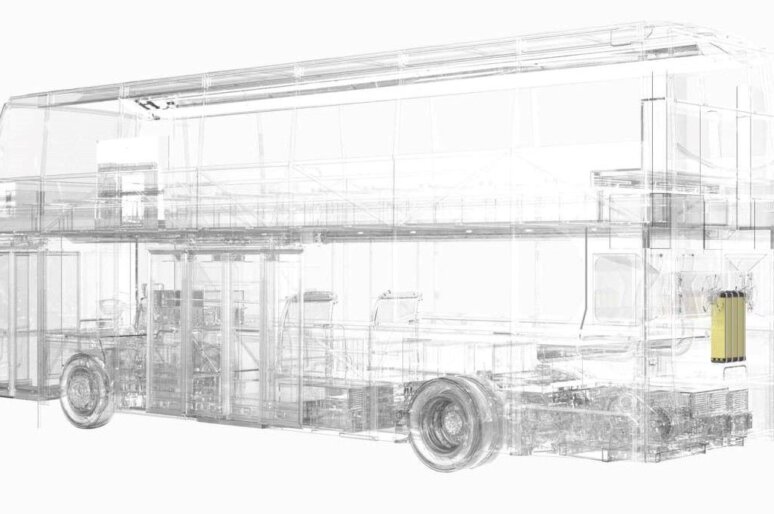
Set to run for 30 months, the Hydrogen Electric Integrated Drivetrain Initiative (HEIDI) project will demonstrate a fuel cell/battery hybrid powertrain on a double-decker bus. Just a single bus is being developed for now.
The project is expected to not only support almost 500 jobs over the next ten years, but also provide CO2 savings of 5.9M tonnes.
The all-new bus drivetrain will be cheaper than the equivalents currently available for large vehicles and is set to use innovative new electronics and energy recovery technologies. The APC has provided £6.3m of funding as part of the Automotive Transformation Fund in support of ambitions to build an end-to-end supply chain for zero-emission vehicles (ZEVs) in the UK. This has been matched by industry to a total of £12.7m.
The University of Bath, along with compressor supplier Aeristech and electric powertrain provider Equipmake, will support fuel cell specialist Bramble Energy, which leads the project, in the development of the hydrogen fuel cell-powered bus. Key aspects of the testing and validation process will be conducted at the state-of-the-art IAAPS research and innovation centre near Bristol.
IAAPS – which is a commercial subsidiary of the University of Bath – is a world-leading centre of excellence for research and development of clean, efficient and affordable zero-carbon propulsion technologies based at the Bristol & Bath Science Park.
Professor Richard Burke, Academic Director of IAAPS, said, “This project will represent a major step towards commercialisation of affordable hydrogen fuel cell vehicles. Whilst hydrogen will not solve all our mobility challenges, it certainly has a significant role to play across many vehicle types and the HEIDI project will demonstrate its use as complement to Battery Electric Vehicles.
“For IAAPS, this project is significant as it represents the first opportunity for us to test a full fuel cell system, progressing our research from air handling and simulation of the stack to full system experimentation.”
Dr. Tom Fletcher, Lecturer in Electrified Automotive Propulsion Systems, who is leading the project at IAAPS and the University, added, “Two strategic hurdles for fuel cell powertrains are development cost and lifetime uncertainty. By embedding digital innovation, the HEIDI project will accelerate the development of future fuel cell powertrains. This project will involve the development of scalable fuel cell and vehicle models, validated through state-of-the-art HiL testing, and will serve as a template for sustainable and equitable mobility solutions.”
The APC supports the UK Government to deliver its aspiration for net-zero road transport while growing the UK’s automotive sector creating jobs and growth. It runs funding competitions throughout the year at Get Involved – Advanced Propulsion Centre (apcuk.co.uk).
Pictured above: A diagram of the new bus showing the drivetrain at the back of the vehicle (Credit – Equipmake and Bramble Energy)